

Why do we see failure when we’re actually succeeding?

Earn better.

Welcome to Ladies Get Paid, a weekly newsletter helping women expand their worth, inside and out. Was this sent to you? Subscribe here so you don’t miss the next one.


This is for anyone who is really hard on themselves.

I was shocked to see the stats on my podcast. There in my inbox was Spotify Wrapped, congratulating me on (apparently?) beating out most of the other podcasts on their platform.

In the top 15% of videos. More shares than 97%. Outpaced 72% of other show’s growth. Listened to longer than 87%.

Meanwhile, I’d thought it was a failure.

For months, I’d been opening my podcast dashboard and feeling that familiar sinking feeling. I’d fixate on individual episode views and think, “This isn’t working.” I had convinced myself that unless I was getting millions of downloads, the whole thing was pointless.

Then Spotify sent me these numbers, and I had to confront an uncomfortable truth: my perception of reality had been completely distorted.


And here’s the kicker – even after seeing those stats, I saw someone else post a similar Spotify Wrapped, and suddenly I was questioning everything again.

It got me thinking: how can our self-perception be so off?

Why do we default to seeing the negative?

And most importantly, how can we learn to see things as they actually are, without the constant filter of judgment?


What’s Happening in Your Brain

This distortion isn’t a personal failing – it’s your brain doing exactly what it was designed to do.

  1. Negativity Bias: Your brain is wired to prioritize negative information over positive. This made sense when missing a threat could mean death, but now it means you’ll remember the one critical comment over the ten positive ones. Research shows we need approximately five positive experiences to counterbalance one negative one. Your brain literally gives more weight, more attention, and more storage space to what goes wrong.

  2. Selective Attention: When you decide something is true (“my podcast is failing”), your brain becomes a heat-seeking missile for evidence that confirms it. This is called confirmation bias. You’ll unconsciously scan for the low download numbers while your eyes skip right over the engagement metrics, the growth trends, the shares. Your brain isn’t showing you objective reality – it’s showing you a curated highlight reel of your existing belief.

  3. Comparative Processing: Your brain constantly benchmarks against others to assess threat and status – another survival mechanism. But on social media, you’re comparing your behind-the-scenes to everyone else’s highlight reel, and your internal experience to their external metrics. When I saw that other creator’s stats, my nervous system registered it as a threat to my status and safety, triggering an immediate reassessment of my own success.

he result? You can be objectively succeeding while feeling like a failure. The data says one thing; your nervous system believes another.


What to Do About It

In the moment, when you’re spiraling:

  • Name what you’re experiencing: Simply saying “I’m in a negativity spiral” or “I’m comparing myself to someone with completely different circumstances” can create just enough space between you and the thought. You’re not stopping the thought – you’re just acknowledging it’s a thought, not a fact.
  • Get specific with your comparisons: When you catch yourself comparing, get granular. Ask: How long have they been doing this? What resources do they have? What’s their team size? Am I comparing my Year 2 to their Year 10? Most of the time, you’ll realize you’re comparing apples to spaceships.
  • Anchor to one objective metric: Pick a single number that represents genuine progress in your work – for me, it was the growth percentage. When your brain starts spinning stories, come back to that one concrete data point. Not as the whole truth, but as a tether to reality.

Ongoing practices:

  • Establish your own definition of success in advance: Before you launch something, before you check the stats, write down what success actually means for this project at this stage. Be specific and realistic. For my podcast, “success” in Year 1 might be: publishing consistently, getting comfortable on camera, building an archive of 20+ episodes. Not: going viral or monetizing.
  • Practice the “And” instead of “But”: When you notice success, don’t let your brain immediately negate it. Instead of “The stats are good, but someone else is doing better,” try: “The stats are good, and there are people ahead of me, and I’m making real progress.” Both things can be true. You can be succeeding and not be at your end goal yet.
  • Audit your input: What are you consuming that feeds the distortion? If scrolling through other people’s wins consistently makes you feel like you’re failing, that’s information. You don’t have to quit social media, but you might need to curate more carefully or limit your exposure during vulnerable moments.


Your Turn

  • What’s something in your work or life that you’ve labeled as “not good enough” or “failing”? What objective evidence do you actually have about this?
  • If you removed all comparison to others, what would success look like for this thing at this stage?
  • What evidence of progress or success have you been unconsciously dismissing or minimizing? (Be specific – write down at least three things.)
  • What would you say to a friend who showed you the same “failing” situation you’re experiencing? (Often we can see others’ situations more clearly than our own.)
Hit reply and tell me: What’s one thing you’ve been calling a failure that someone who loves you would see as a success?


Now go get paid.

x Claire


PS Loved this newsletter? Pay it forward by sharing it with someone who could benefit 🤗

Resources

Looking for a job?

LLC of Me

Dreaming of a new career?

Pivot Pathfinder

Preparing to negotiate?

Earn Better

Seeking guidance?

Explore Coaching

“I can see what I want, but I have no idea how to get there.”

After my client Bea’s federal job imploded, she landed quickly—but five months in, her senior director left. Now she faced a fork in the road: step into big leadership or shrink back. The problem? Bea felt completely unequipped.

In this week’s coaching session, we uncovered the real issues: Bea was waiting to “feel confident” before taking action. She was trying to achieve her way to information instead of building strategic relationships. And she was viewing her colleagues as obstacles instead of allies navigating the same chaos.

video preview


In this week’s Substack, I break down:

  • Why confidence isn’t a destination—it’s a daily practice (and how to do it)
  • The morning check-in that helps you work WITH your inner critic instead of against it
  • How to build allies before you even know what you’ll need them for
  • The listening tour script that gets leadership to actually open up

I work with women who want more out of their career, and their life.

I have the capacity to take on a few more clients this quarter. These are the situations I specialize in (any sound familiar?):

  • The Golden Handcuffs Client: Well-compensated but soul-starved. You want meaningful work but can’t afford to sacrifice financial security—especially with a family depending on you. The thought of starting over feels paralyzing.
  • The Ambitious Achiever Who Hit a Wall: You do everything “right”—stellar performance, great relationships, impressive results—but you’re not advancing as expected. You get to final rounds but don’t close the deal, and you can’t figure out why.
  • The Brave Leaper in Analysis Paralysis: You’re already mid-transition but frozen by overthinking. You have courage but lack clarity, strategy, or confidence. Every option feels like it could be the “wrong” choice.
  • The Expert Stuck in Your Expertise: You have deep knowledge and experience but struggle to translate it into something marketable. You’re caught between your established identity and who you’re becoming.

If any of these resonate, you’re not broken. You’re at a critical inflection point that requires both strategic clarity AND the internal tools to execute with confidence.


Why Choose Me

Most coaches give you either strategy OR mindset work. I seamlessly weave together:

  1. Practical next steps with the internal alignment work needed to execute them
  2. Strategic roadmapping with tools to manage your present so you have bandwidth for your future
  3. Market positioning with the confidence to own your worth and negotiate from strength

I don’t push you to quit your job tomorrow or take dramatic leaps. Instead, I help you see your current paycheck as “a venture capitalist funding your transition” so you can shift to a more empowered position.

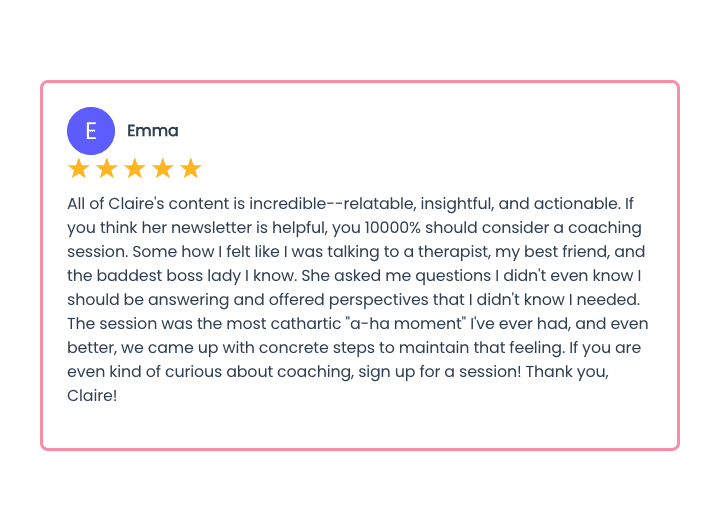
As one client put it: “Claire holds my hand and kicks my butt at the same time.”


I provide gentle support when you’re struggling with fear and self-doubt—and firm accountability when you’re making excuses or avoiding necessary action. I won’t let you stay stuck in planning mode or let perfectionism sabotage your progress.


The Real Reason My Coaching Works

Here’s what I’ve learned after working with thousands of women: When you say you want a “career change,” what you really need is alignment between who you’ve become and how you show up professionally.

The surface problem is job dissatisfaction. The real problem is identity evolution.

I’ve lived through the messy, complicated reality of major life transitions. I know what it feels like to be successful on paper but lost inside. I understand the fear of making the “wrong” choice when everything feels high-stakes.

My approach is to turn my life inside out—taking what I’ve learned (mostly through struggle) and breaking it down in a way that’s accessible and actionable for you.

This is for anyone who is delivering great work but not getting the recognition they deserve.

I’m excited to bring you a guest post by Shivani Berry, CEO & Founder of Career Mama and LinkedIn Top Voice. Shivani almost got fired before realizing that hard work isn’t what gets you ahead – it’s visibility. She shares practical strategies to help you gain recognition and move up.

I almost got fired before I learned this lesson: Talent doesn’t get you recognized. Visibility does.

As Monetization Lead at Intercom, a multi-billion dollar company, I was leading a year-long pricing redesign. Everything was on track. But instead of sharing updates, I decided to wait until we hit a key milestone.

Bad move.

Leadership started losing confidence. Not because the project was failing but because they had no idea what was happening. In the absence of updates, they assumed the worst. My manager jumped in. I was getting managed out. I scrambled to fix things. My stress landed me in the ER.

When I finally started sharing updates, they were transactional. Just actions. Leadership still couldn’t see my value. It wasn’t until I started framing my work strategically (showing how it connected to company goals) that everything shifted.

I rebuilt my reputation. A few months later, the CEO tapped me to lead a company-wide initiative.

The difference? I stopped reporting what I did and started showing why it mattered.

The experience taught me two painful lessons:

First, silence kills trust. If you don’t share your work, people assume nothing is happening.

Second, sharing by itself isn’t enough. You have to make it obvious how your work helps the company.

I’ve since coached 5,000+ high-performing women at companies like Google and Uber. And I see the same pattern everywhere: brilliant women doing exceptional work, convinced it should speak for itself.

It won’t.

Why “Good Work Speaks for Itself” Almost Got Me Fired

As an Indian immigrant daughter, I was taught: keep your head down, deliver, let your work speak for itself.

That advice nearly destroyed my career.

The reality is: You’re not rewarded for execution. You’re rewarded for recognized impact. Your leaders can only advocate for what they see. If your impact isn’t visible to them, they can’t (and likely won’t) advocate for you.

The Real Problem: You’re Quietly Collaborating With Invisibility

Many high-performers sabotage themselves without realizing it. They wait until work is perfect (silence looks like drift, not focus). They make leadership work too hard with lengthy updates packed with details.

Visibility isn’t about being loud. It’s about being clear. Making yourself visible isn’t bragging. It isn’t self-promotion. It’s just consistent, thoughtful narration that showcases your leadership skills and converts your value into trust.

The System That Changes Everything: The Visibility Flywheel

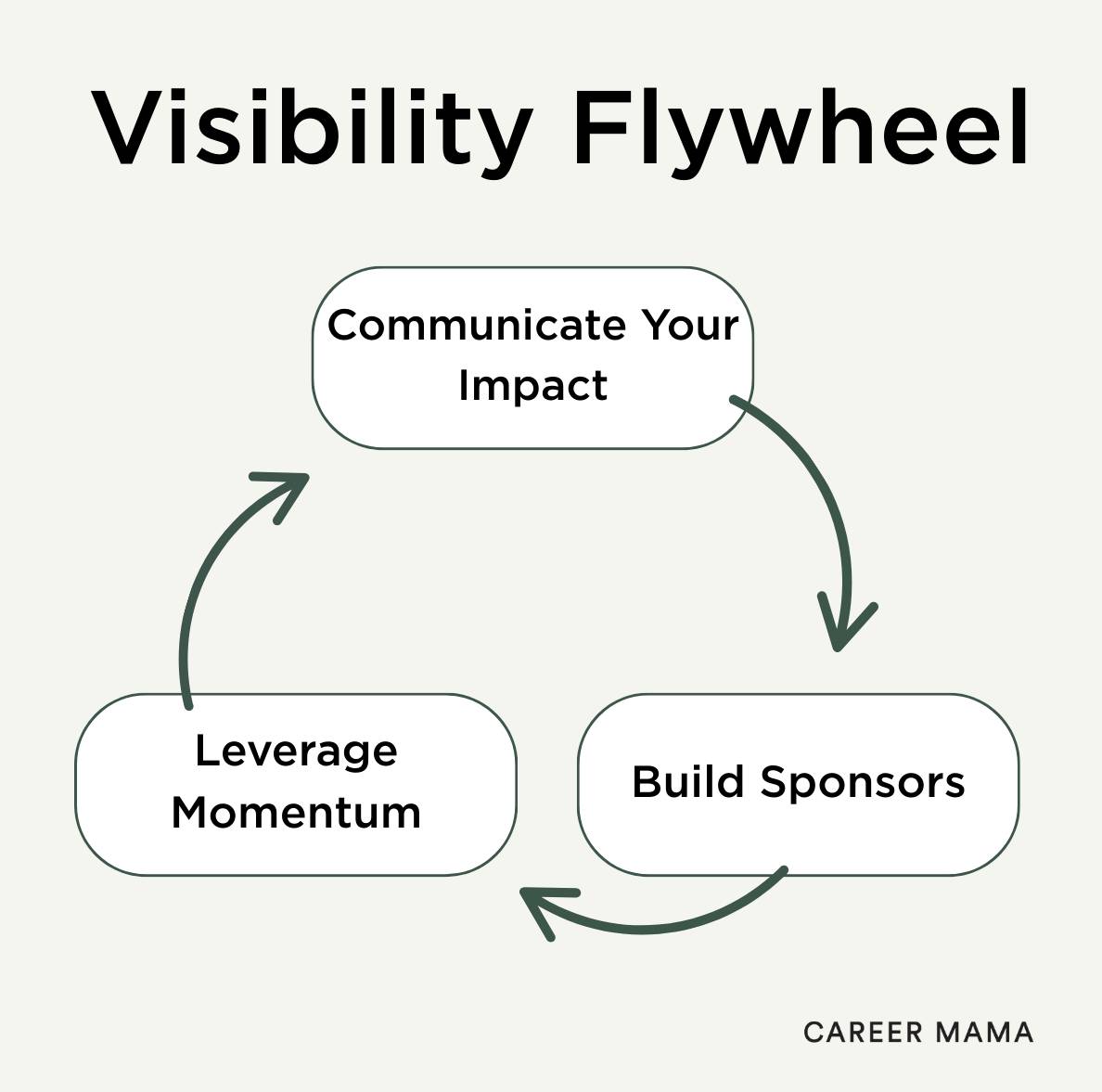
Once I started treating visibility like a system, everything changed. If you’re doing great work, use my Visibility Flywheel to make your impact visible, build sponsors, and turn recognition into opportunity.

1. Communicate Your Impact

Every message should remove friction for your reader. They should instantly know why it matters, what changed, and what you need from them.

Use the CARE Framework to share compelling updates:

  • Context: Tie your update to a goal or risk they already care about. “Goal: reduce onboarding time this quarter.”
  • Action: Say what you did in one sentence. “We removed two steps that caused the most drop-off.”
  • Result: Share movement, even if directional. “Ramp time dropped 18% in the pilot.”
  • Expectation: Tell them your ask or what’s next. “Decision: approve 2 days of design support to ship by Tuesday.”

That’s it. Four lines. One screen. Zero confusion.

Examples:

❌ “I led a Q2 dashboard cleanup.” ✅ “I identified operational inefficiencies costing us 10 hours weekly. The team reduced waste by 40% based on my findings.”

❌ “We’re finalizing copy to launch next week.” ✅ “We refined copy to reduce friction. Once design finalizes, we launch next week. If it slips, I’ll prioritize the highest-impact screens first.”

To help you with this, download these free plug-and-play scripts and templates in the Recognition Toolkit you can use in 1:1s and emails to quickly explain your impact with clarity and confidence.

2. Build Sponsors

Visibility grows through relationships. Promotions happen in rooms you’re not in. You need sponsors who will advocate for you.

  • Ask for feedback and goals: “What are you most focused on right now?” “What would make you love this instead of just like it?”
  • Share the stage: Publicly thank collaborators. “Thanks to [peer] for pulling the data, saved us two days of rework.”

3. Leverage Momentum

Don’t let recognition end at “Good job.”

  • Shape the story after the spotlight: When praised, link it to where you want to grow. “Leading this launch showed me how much I enjoy cross-functional work. I’d love to take on more next quarter.”
  • Share learnings: Leaders don’t expect perfection. They expect pattern recognition. “One thing I’d change next time: align with Ops earlier for a smoother rollout.”

Visibility isn’t a moment; it’s an ongoing cycle:

👉 Communicate your impact

👉 Build sponsors

👉 Leverage momentum

👉 Repeat.

Each cycle reinforces your visibility, deepens trust, and compounds your reputation capital.


To help you understand what to focus on to get the recognition you deserve, use this 2-minute Promotion Readiness Calculator. You’ll quickly identify improvement areas and learn actionable visibility strategies you can apply today to get noticed and promoted faster.

The Reframe

Visibility isn’t about doing more. It’s about narrating the value of what you’re already doing.

You’re not invisible because you lack talent. You’re invisible because you were taught that impact should speak for itself.

But impact doesn’t speak. People do.

When you follow the Visibility Flywheel, you stop waiting to be seen and start shaping how you’re known.

Ready to build your visibility system? Download the free Recognition Toolkit with plug-and-play scripts and templates you can use in 1:1s and emails to explain your impact with clarity and confidence.

Hi, I’m Claire Wasserman and I help you expand your worth, wealth, and wellbeing.

I’d love to support you – learn more here.

Leave a Comment

Your email address will not be published. Required fields are marked *