Bring the founder of Ladies Get Paid to your stage.
Ten years ago, Claire Wasserman started asking women to sit in a circle and tell the truth about money and work. That circle became Ladies Get Paid, a community of 50,000+ women who’ve negotiated raises and learned to say their numbers out loud. Claire brings that decade of listening to your stage: warm, direct, in your audience’s corner from the first minute.
“Engagement was off the charts.” Allie Pacelli, Reddit
Talks and workshops · in person or virtual

See her on stage
She’s brought this work to








Featured in The New York Times and The Wall Street Journal, on Good Morning America, and recognized by the White House.
Three talks. Ten years inside this community taught us that the pay gap is structural, and that confidence is where it shows up. Capable women rarely lack information. All three send your audience home with tools they’ll use that week, because that’s the standard our community holds us to.
Rewrite Your Money Story
How to achieve real financial freedom
If you had to share your salary with a stranger, would you? What about a friend? If the mere thought makes your toes curl, you’re not alone.
Nearly a decade ago, Claire Wasserman started hosting “talking circles” for women to discuss their relationship to money. It exploded into a global movement of 50,000 members, elicited a lawsuit from men’s rights activists, and led to a major book deal.
That’s because money isn’t math. It’s a proxy for power, safety, and belonging, which is why what we earn, or don’t, becomes a referendum on our worth.
In this keynote, Claire shares what financial freedom actually is: feeling steady on the inside regardless of what’s happening on the outside. How to get there, and how to hold onto it when your circumstances change. Drawing from her training in financial psychology and nervous system regulation, along with building a seven-figure business, losing it all, and going on food stamps, she goes deep into where your money beliefs are held, why you’ve stayed stuck in “bad” money habits, and most importantly, what it actually takes to change.
Your audience will learn:
- Where their money beliefs came from, and how to act from intention instead
- What’s happening in their nervous system when money triggers them, and what to do in the moment
- How to stay grounded when their financial circumstances change
- How to enjoy what they have without guilt, and without the reflex that it should be more
- How to talk about money without shame or discomfort
- How to earn what they’re actually capable of
Best for: professional and industry women’s conferences, women’s initiatives, financial wellness programming, and financial services audiences.
How to Sell Yourself Without Feeling Sales-y
A three-part method for making your case
You know you’re good at what you do. Saying it out loud is the problem.
So you undersell it, or you overexplain, or you talk about yourself in a way that feels so uncomfortable you rush to get it over with. And when the answer comes back no — the job, the raise, the greenlight, the deal — you don’t hear it as a fit issue. You hear it as something about you. Enough of those and you conclude you’re simply bad at this. (You’re not.)
It’s just that selling yourself can feel sales-y. But it doesn’t have to.
In this session, Claire Wasserman walks through a three-part method for selling yourself without feeling sales-y. It starts by taking you out of your own head and into the perspective of the person you need something from — because you can’t know what makes you valuable until you know what they need. Then it shows you how to talk about your work in terms of the problems you solve and the way you solve them, which is both more persuasive and easier to say than a list of your qualities. And it ends with the part most people skip: getting other people to make your case for you.
Along the way, Claire names what actually stops you at each step — the guessing, the minimizing, the fear of imposing — and what to do in the moment it shows up.
Your audience will learn:
- Questions that reveal what the other person actually needs, and make them look sharper for asking
- How to identify what makes them distinct: their perspective and their process, not a list of adjectives
- Why they minimize their own work, and how to reconstruct what was genuinely hard about it
- The language that undercuts them — hedging, caveating, overexplaining — and what to use instead
- How to ask for a referral, introduction, or testimonial in a way that’s easy to say yes to
- What to do when the discomfort shows up mid-conversation, so it doesn’t run the exchange
Best for: leadership and professional development programming, association conferences, and corporate audiences whose people need to win buy-in for an idea, a project, or themselves.
Earn Better: How to Negotiate Your Salary Like a Pro
The P.A.I.D. Method for getting the money you deserve
Over a career, the wage gap costs the average woman somewhere between $500,000 and $1.5 million. Negotiating is the fastest way to close it.
So why don’t we? Partly because the other side has information we don’t — how the range was set, what’s flexible, what HR is optimizing for. And partly because asking for more requires a kind of self-advocacy women are actively socialized against. So you take the first number, or you ask for more and apologize your way through it.
This is a working session, not a pep talk. Claire Wasserman spent years in recruitment and has led career development training at hundreds of companies, which means she’s been on the other side of the table — she knows how compensation decisions actually get made and where the room to move usually is. She’s even taught this method at Harvard Business School.
You’ll leave with your own numbers, your own language, and a plan for the specific conversation you’re walking into.
Your audience will learn:
- How to research their market value, including the questions to ask HR about compensation philosophy before naming a number
- A three-number framework: the ask, the target, and the walk-away
- How to quantify their work in dollars, money made and money saved, so they read as an investment rather than an expense
- What’s actually on the table besides base salary, and which pieces are easiest to win
- How to tell their story so the ask feels collaborative instead of adversarial
- What to say when they’re asked what they currently make, or when the first number comes in too low
Best for: career development and pay equity programming, women’s initiatives, and association conferences where the audience is heading into offers, reviews, or promotions.
Looking for something else? Claire also speaks on making good decisions under pressure and on quieting the inner critic. Just ask.
She carries 50,000 women’s stories with her. Claire has spent a decade listening to this exact room. She names what your audience is feeling before they say it, and they recognize themselves, because thousands of women have said it to her first.
She’s lived it, publicly. Divorce, a lawsuit, a business that ended overnight, a son born with a serious medical condition, a seven-figure company turned into six figures of debt. Claire doesn’t hide behind polished talking points. What she teaches about worth and steadiness, she learned in her own body, and audiences can tell.
She hands over tools. An inspiring talk fades by Friday. Claire’s talks come with frameworks people keep using, and event planners tell us attendees reference her sessions months later.
The throughline in everything she teaches: after years of coaching, Claire kept finding the same thing underneath. What looks like a confidence gap is usually a self-trust gap. No one gets talked out of it. Claire gives them a way through it.
“She was one of our highest-rated speakers. On a recent call, our sponsor contact shared she’d been promoted, and cited Claire’s seminar as the key resource she used to negotiate her new role.”
Nicole Soluri, Professional Business Women of California
“Engagement was off the charts. More than one person said they wished we could have talked another hour.”
Allie Pacelli, Reddit
“I have not learned more in one presentation in a very long time, if ever.”
Attendee, Eaton
“The most actionable approach I’ve seen. I’m ready to put it to work and stand up for myself.”
Attendee, Facebook
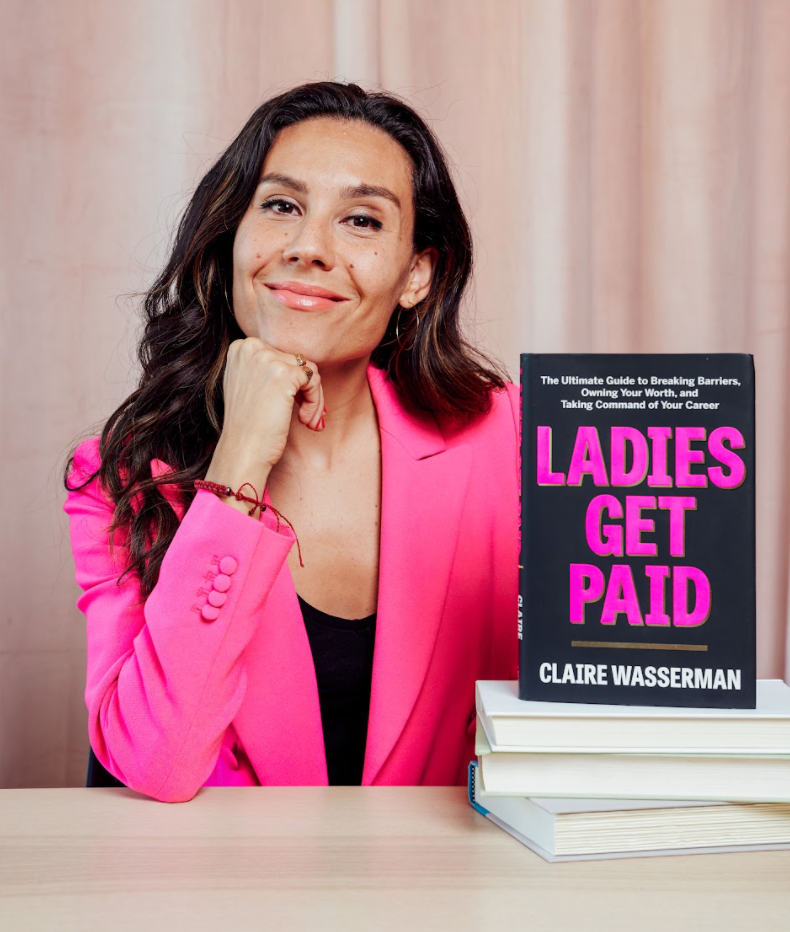
Claire Wasserman is the founder of Ladies Get Paid. She grew it from a single town hall into a seven-figure business and a community of 50,000+ women, and wrote the book of the same name for Simon & Schuster. She’s taught at NASA, Harvard Business School, Google, and the United Nations, appeared on Good Morning America and in The New York Times, and produced six conferences, including one for 10,000 people online. She holds a degree in sociology and a Master’s Certificate in Financial Psychology. PayPal booked her for a workshop and turned it into a national year-long series.
Ready to bring Claire to your event?
Let’s talk about your event
Tell us what you’re planning. Claire reads every inquiry and replies herself, with availability and what a session could look like for your audience.
You’ll hear back within 2 business days.
Also available for executive retreats, leadership offsites, and ongoing partnerships.
“She was one of our highest-rated speakers. On a recent call, our sponsor contact shared she’d been promoted, and cited Claire’s seminar as the key resource she used to negotiate her new role.”
Nicole Soluri, Professional Business Women of California