Welcome to Ladies Get Paid, a weekly newsletter to expand your worth, inside and out. Was this sent to you? Subscribe here so you don’t miss the next one.
This is for anyone who wants to ask for more without seeming “difficult.”
My client (let’s call her Jenna) came to me after a fintech company reached out about a senior role. She’d been passively open to leaving her current startup, where leadership dysfunction was driving people out despite a team she liked.
But here’s what made this different from her last job change: she’d negotiated that one without prep and knew she’d left money on the table. This time, she wanted to do it right.
Her situation:
- Current base: $205K
- Current total comp (including bonus, 401k match, stipends, health insurance): ~$238K
- The new company’s initial offer: $215K base + $70K/year in equity
- What they weren’t offering: bonus, 401k match, professional development stipend
- Her health insurance costs would increase by $4K/year
The good news:
- They came to her – the hiring manager personally re-initiated the process
- The panel feedback was glowing
- They negotiated in good faith (no lowballing, no exploding offers, no pressure tactics)
- They offered $5K above their stated ceiling
The Math Problem
On paper, the $10K base increase looked good. But when Jenna calculated what she’d be walking away from:
What she’d lose:
Annual bonus | ~$10K
401k match | ~$6K
Professional development stipend | $2K
Health insurance cost increase | $4K
Total gap | ~$22K
This wasn’t about being greedy—it was about understanding the real numbers.
The Strategy We Built
Here’s what I told her: HR typically expects candidates to negotiate 10-20% above the initial offer. They don’t expect you to say yes to the first number.
But how do you ask for more without seeming difficult?
The script:
“I really appreciate the lift in base—that’s my priority, especially with rising costs. However, I was surprised by some of the gaps in total comp compared to my current package. When I calculated what I’d be leaving on the table—bonus, 401k match, professional development, plus increased healthcare costs—it comes to around $22K. Of course, I know the base increase offsets some of that, and I’m grateful for it. But I was hoping we could get closer to $235K. If we can get there, I’ll say yes today.”
Why this works:
- Anchor high with rationale. The $22K number plants a big figure in their mind—even though she’s not asking for all of it.
- Acknowledge what they’ve done. Saying “I appreciate the lift” signals she’s collaborative, not combative.
- Make base the priority. By being explicit, she prevents them from throwing equity or other things at her to distract from what matters.
- Create urgency in her favor. “I’ll say yes today” is a gift to them—they can close this and move on. That’s valuable.
- Strategic transparency. No games, no smoke and mirrors. Just: here’s my math, here’s my ask, help me figure this out.
The back up plan:
If they pushed back on $235K, she was ready to say:
“If base is capped, could we bridge the gap with a signing bonus? That would help offset what I’m leaving in year one.”
What Made This Different From Her Last Negotiation
Last time, she got backed into a corner. The recruiter called, threw out a number, and pressured her to respond before she had the full picture. Jenna said yes too fast.
This time:
- She asked for the full package before responding
- She did the math on what she was actually giving up
- She practiced the script
- She remembered: they want her. She has leverage.
The mindset shift:
The biggest thing I told her: They expect you to negotiate. The first number is never the final number. And framing it as “help me say yes” turns it from adversarial to collaborative.
Remember, you’re not demanding. You’re problem-solving together.
The Outcome
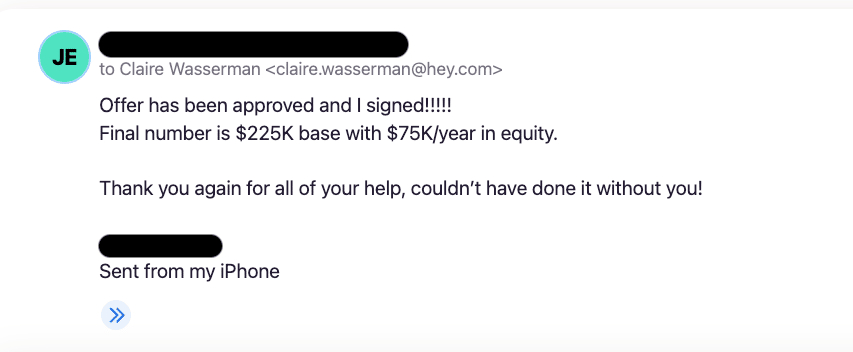
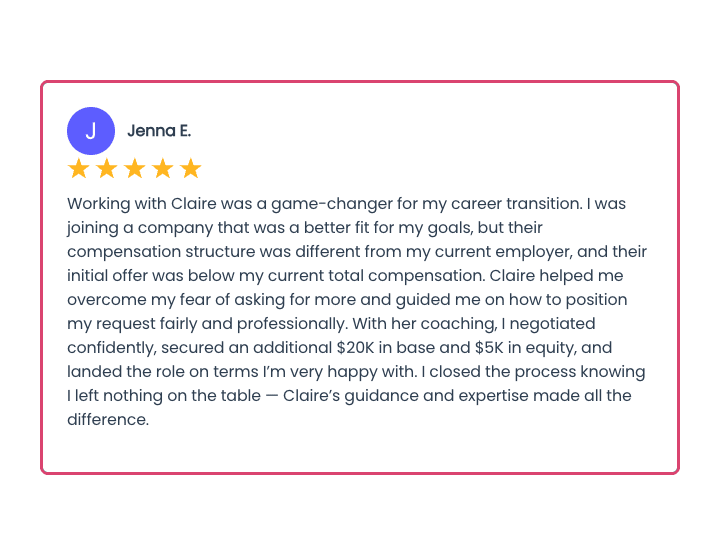
And then she wrote me this beautiful testimonial 🙂
Are You Ready to Make More?
Jenna’s story isn’t unique. Most people leave money on the table—not because they’re bad negotiators, but because they go in without a strategy, without the math, without the scripts.
The difference between her first negotiation and this one? Preparation. Knowing her numbers. Having someone in her corner to workshop the what-ifs.
If you’ve got an offer on the table (or one coming), I start with private 30-minute strategy sessions where we:
- Calculate your real total comp gap (not just base vs. base)
- Build your custom script—what to say, how to say it, what to do when they push back
- Role-play the conversation so you walk in confident, not hoping you’ll find the right words
If you’re earlier in the process—or just want to understand the fundamentals before you invest—start with my free 90-minute training: P.A.I.D. Method: How to Negotiate Your Salary and Earn Better.
I walk through the psychology of negotiation, the three numbers you need to know before any conversation, and the exact phrases that get results without making you feel greedy.
And if you want to do the work alongside it, grab the $17 workbook that includes:
- The total comp calculator Jenna used
- Fill-in-the-blank scripts for every scenario
- The “what if they say no” decision tree
Now go get paid.
x Claire
PS Loved this newsletter? Pay it forward by sharing it with someone who could benefit 🤗
|
|
|
Looking for a job?
Dreaming of a new career?
Preparing to negotiate?
Seeking guidance?
|